



If you expect an asset’s price to fall, you go short (sell) instead. You profit if the price drops as predicted and make a loss if it rises unexpectedly. You believe the market is about to experience a short dip, and are concerned how this will affect the value of your portfolio. Once your account is set up and you’ve devised a trading plan, it is important to determine how much you are willing to risk to formulate an appropriate CFD risk management strategy. If you are risk-averse, then you will be looking for opportunities with lower risk-to-reward (R-R) ratios. The price falls to $160, giving you a profit of $1,000, or $10 per share.
Can I profit when markets fall?
A neutral way to assess fit is to compare what CFDs are good at with the situations where another approach may be more appropriate. With FXTM, you can use the industry’s most popular platforms to trade CFDs across shares, indices, commodities. MetaTrader is complete with updated tools to give you a smooth, user-friendly CFD trading experience. Traders use a smaller portion of their own capital when opening a position, which allows for potentially bigger returns. That said, it’s important to remember that leverage carries the same potential to increase losses as it does to boost profits. Leveraging with CFDs carries risk, as a small market movement may have a much greater impact on the value of your investment, which could work against you.
- At the same time, on the ExDate the dividend amount is cut from the share price, resulting in a profit on your position.
- To profit from CFD trading, it’s essential to have a deep understanding of the markets and the specific assets you’re trading.
- We recommend that you seek independent advice and ensure you fully understand the risks involved before trading.
- While it shares risk and speculation attributes with gambling, CFD trading is based on financial strategies and market analysis, distinguishing it from pure gambling, which relies on chance.
- CFDs are priced based on the value of the underlying asset, with adjustments to reflect transaction costs like spread, commission and overnight charges.
- At Saxo, we always want to be transparent with you about any possible risks when you trade.
Learn how CFD profit and loss works
When traders keep positions open beyond the daily trading session, they may be subject to a holding cost calculated based on the notional value of the position and prevailing interest rates. Leverage and margin are two essential concepts in CFD trading that allow traders to amplify their trading positions and potentially increase their profits. Regardless of the asset type that you are trading, the principle of how profit and loss is calculated on a CFD trade is the same. Whether your CFD is in gold, GBPUSD or the NASDAQ 100 Index, you won’t own the underlying asset, but are instead speculating on how the asset’s price will move. CFD markets are global and therefore benefit from increased trading volumes.
Step 1 – Choose a Regulated CFD Broker
In this section, we will comprehensively review the main aspects to look into when choosing a CFD broker. Determining when to enter and exit a trade is fundamental to success. To define these points, beginners can start by analyzing charts and looking for patterns that suggest favorable entry and exit opportunities. Support and resistance levels on charts can serve as valuable guides. Additionally, technical indicators can be used to gain more information on the asset.
If you opened your position by buying, you could close by selling the same number of contracts at the sell price – and vice versa. CFD margin requirements can vary depending on the market that you’re looking to take a position on – and not all of our markets will have the same margin rate. For example, we require a deposit equal to 5% of the total position size on popular indices like the FTSE 100, or 20% on shares such as Tesla. Leverage in CFD trading enables you to get full market exposure for a small initial deposit, known as margin.
How to Buy a CFD?
CFD assets traded without leverage have the same risk as those assets traded directly. However, trading CFDs with leverage increases your market exposure, thereby, increasing your risk. Most people who use CFDs are short-term traders or day traders, although CFDs can be used in buy-and-hold strategies if you use no leverage. In order to find more success in trading, you need to know how to use technical analysis, including technical trading indicators. Keep in mind that as CFDs are leveraged products, you only ever need to put down a small deposit to gain exposure to the full value of the trade. This means your capital goes further but also means that you could lose more than your initial outlay.
Having a great range of options lets you easily diversify your portfolio. The trading platform should be a deciding factor when choosing a CFD broker because it serves as the interface through which traders access the financial markets. A user-friendly and feature-rich trading platform is essential for executing trades effectively.
Markets
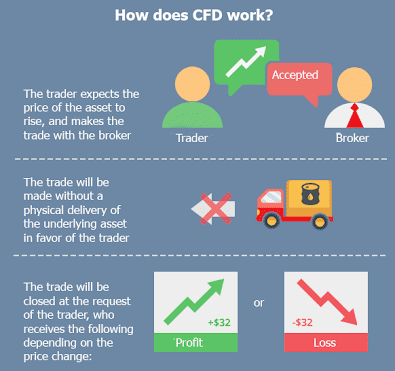
The net profit of the trader is the price difference between the opening trade and the closing-out trade (less any commission or interest). The first trade creates the open position, which is later closed out through a reverse trade with the CFD provider at a different price. CFD Trading offers several major advantages that have increased the instruments’ enormous popularity in the past decade.
Key Features of CFDs
A CFD is based on an underlying asset, such as a stock, index, or commodity, but ownership is not transferred at any point. The contract reflects the price of that asset, and its value changes as the underlying market price changes. This structure distinguishes CFDs from traditional investing, in which ownership rights, such as dividends or voting rights, may apply.
Short-selling CFDs in a falling market
By short-selling the same shares as CFDs, you can try and make a profit from the short-term downtrend to offset any loss from your existing portfolio. If this happens, you may get a margin call from your provider asking you to top up the funds in your account. If you don’t add sufficient funds, the position fxverge scam may be closed (stop out) and any losses incurred will be realized.
Stocks
These risks arise from the structure of the instrument itself, not from how it is used, which makes understanding them essential before considering how CFDs function in practice. Because CFDs combine market exposure with leverage, even relatively small price changes can have a significant impact on the value of a contract. Remember that in a high-volatility or low-liquidity environment, slippage may lead to opening or closing the position at a different level.
Learning about stocks? See how investing works in practice
This position mirrors the movement of company XYZ’s stock price, allowing you to profit if the price rises or incur losses if it falls. When trading CFDs, an investor does not actually own the asset itself. Instead, investors can trade derivative instruments such as CFDs, which track the price of the actual asset (known as the “underlying asset”).
The forex market is the largest and most liquid financial market globally, with trillions of dollars traded daily. In CFD trading, investors can trade a wide range of currency pairs, such as EUR/USD and GBP/USD, as well as minor pairs. When looking at CFD trading apps, traders should consider ease of use, speed of trade execution, and compatibility with their mobile devices. Many CFD brokers offer apps compatible with iOS and Android devices, allowing traders to access their accounts on smartphones and tablets.
A good first step is to get a better understanding of what CFDs actually are. This section and examples below are provided for illustrative and educational purposes only. You think Apple shares are going to appreciate and want to open a long CFD position. You can open a CFD trading account by applying online, verifying your identity, and funding your account – see ‘Opening a CFD trading account’ above for the full steps.